

How to Lead Circle Singing
A digital course with Davin youngs
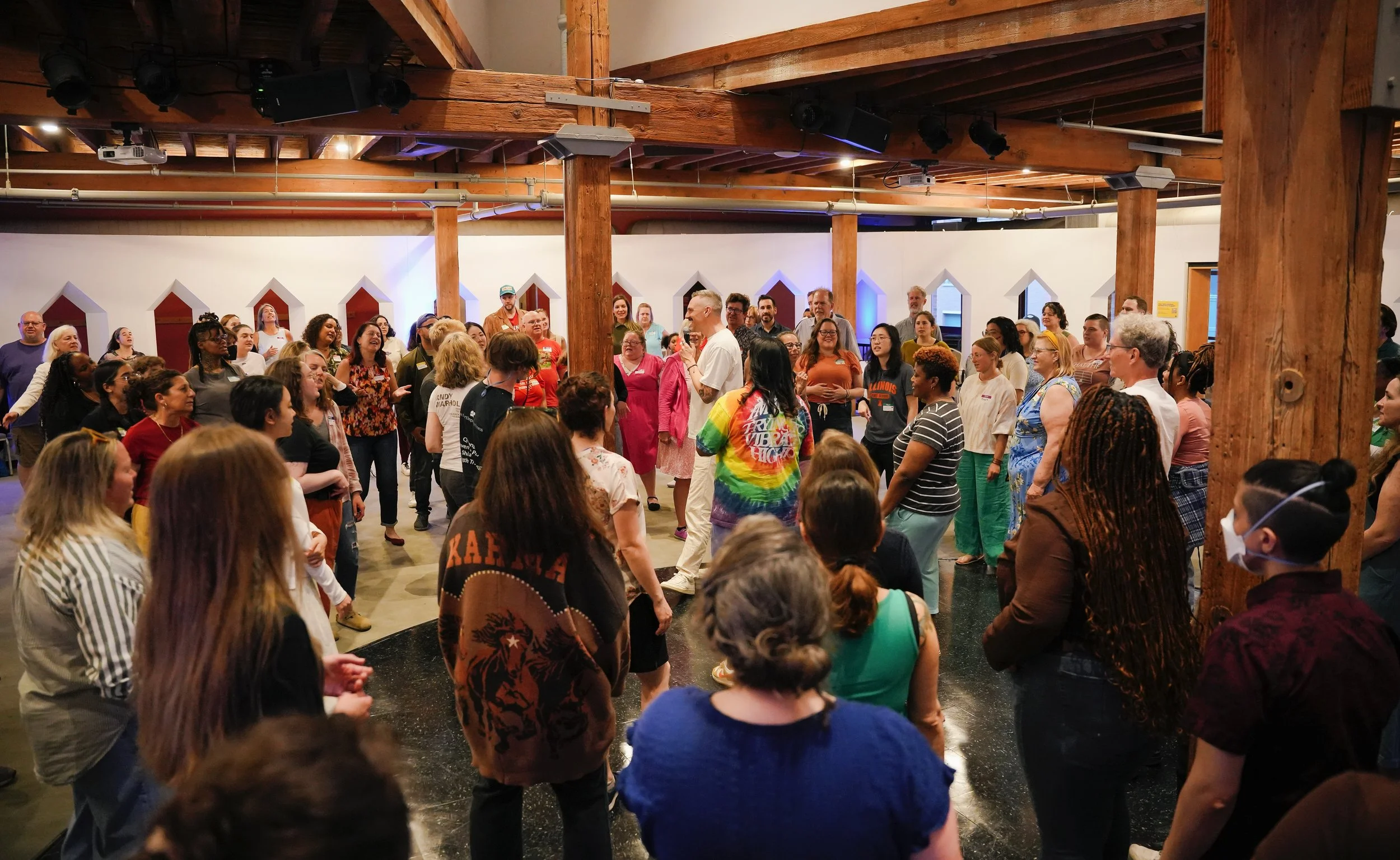
Circle singing is one of the most powerful community singing experiences on the planet.
This course teaches you exactly what you need to know to lead your own circles and bring the joy of collective, improvisational singing to diverse audiences.
-
-
Welcome + My Story
This opening video is an invitation to the course and to the practice. Davin introduces himself, shares the range of people he hopes this course can serve, and tells the story of how he found his way to circle singing, from classical training at Oberlin to a life-changing week at Bobby McFerrin's workshop at the Omega Institute. It sets the tone: playful, honest, non-linear, and deeply rooted in community.
This opening video is an invitation to the course and to the practice. Davin introduces himself, shares the range of people he hopes this course can serve, and tells the story of how he found his way to circle singing, from classical training at Oberlin to a life-changing week at Bobby McFerrin's workshop at the Omega Institute. It sets the tone: playful, honest, non-linear, and deeply rooted in community.
-
-
-
Personal Language: Finding Your Improvisational Voice
Before you can lead others, you need a personal practice. This video introduces one of the foundational tools of circle singing: personal language, a form of free, non-lexical vocal expression that bypasses the limitations of words and taps into something more primal and universal. Davin walks you through four exercises to begin building (or deepening) your own improvisational singing practice.
Before you can lead others, you need a personal practice. This video introduces one of the foundational tools of circle singing: personal language, a form of free, non-lexical vocal expression that bypasses the limitations of words and taps into something more primal and universal. Davin walks you through four exercises to begin building (or deepening) your own improvisational singing practice.
-
-
-
Rhythm and Groove: Finding the beat in Your Body
Rhythm isn't something you think your way into. It lives in your body, and as a circle singing leader, your job is to find it, embody it, and communicate it to the group. This video builds on the personal language practice by adding rhythm and groove as a foundational layer, and offers a sequence of exercises to help you internalize the pulse before you ever step into the center of a circle.
Rhythm isn't something you think your way into. It lives in your body, and as a circle singing leader, your job is to find it, embody it, and communicate it to the group. This video builds on the personal language practice by adding rhythm and groove as a foundational layer, and offers a sequence of exercises to help you internalize the pulse before you ever step into the center of a circle.
-
-
-
The Motor: Building the Engine of a Circle Song
Summary
This video introduces the four-part form at the heart of circle singing, then dives deep into the first and most foundational piece: the motor. Think of it as the bass line, the engine that keeps everything moving. Davin walks through how to create simple, repeatable patterns and offers three specific strategies for making them more dynamic without overcomplicating them. He also introduces Loopy Pro as a practice tool for anyone who wants to explore layering on their own.
Summary
This video introduces the four-part form at the heart of circle singing, then dives deep into the first and most foundational piece: the motor. Think of it as the bass line, the engine that keeps everything moving. Davin walks through how to create simple, repeatable patterns and offers three specific strategies for making them more dynamic without overcomplicating them. He also introduces Loopy Pro as a practice tool for anyone who wants to explore layering on their own.
-
-
-
The Interlocker: Finding the Space Between the Beats
If the motor is the engine, the interlocker is what makes it dance. This video explores the second part of the four-part form, showing how to listen for the empty spaces in your motor and create a complementary pattern that fills them. The interlocker and motor are sisters, the rhythm section of your circle song, and getting them to relate to each other without sounding like each other is where the real dynamic energy lives.
If the motor is the engine, the interlocker is what makes it dance. This video explores the second part of the four-part form, showing how to listen for the empty spaces in your motor and create a complementary pattern that fills them. The interlocker and motor are sisters, the rhythm section of your circle song, and getting them to relate to each other without sounding like each other is where the real dynamic energy lives.
-
-
-
The Melody: Where the Song Emerges
Summary
The melody is where everything clicks into place and starts to feel like an actual song. In contrast to the motor and interlocker, which are rhythmic and percussive, the melody tends to be smoother, more elongated, and more vowel-forward. It is the part you want people walking away humming. This video walks through how to find and develop a melody over an established motor and interlocker, with multiple live examples showing Davin's creative process in real time.
Summary
The melody is where everything clicks into place and starts to feel like an actual song. In contrast to the motor and interlocker, which are rhythmic and percussive, the melody tends to be smoother, more elongated, and more vowel-forward. It is the part you want people walking away humming. This video walks through how to find and develop a melody over an established motor and interlocker, with multiple live examples showing Davin's creative process in real time.
-
-
-
Harmony and Descant: Filling Out the Full Sound
The fourth and final part of the form is harmony, and it is where the circle song fully blooms into something that feels orchestral and choral. This video covers how to add harmony to the melody (and eventually to any part), introduces the concept of the descant as a soaring alternative, and offers practical strategies for leaders who may not consider themselves skilled harmonizers.
The fourth and final part of the form is harmony, and it is where the circle song fully blooms into something that feels orchestral and choral. This video covers how to add harmony to the melody (and eventually to any part), introduces the concept of the descant as a soaring alternative, and offers practical strategies for leaders who may not consider themselves skilled harmonizers.
-
-
-
Leadership in the Circle: Best Practices for Stepping into the Center
You have the tools. Now comes the part that no amount of practice fully prepares you for: actually standing in the center of a circle while people look at you and wait. This video is about what happens in that moment and how to navigate it with grace, presence, and clarity.
You have the tools. Now comes the part that no amount of practice fully prepares you for: actually standing in the center of a circle while people look at you and wait. This video is about what happens in that moment and how to navigate it with grace, presence, and clarity.
-
-
-
Closing: The World Needs Your Circles
This is where the journey ends, and where the real work begins. Davin closes the course with a reflection on why circle singing matters beyond the technical, why connection and community are at the heart of the practice, and what it means to show up as a leader with honesty, authenticity, and an open heart. It is less a lesson and more a send-off, an invitation to take everything you have learned and go make something real with it.
This is where the journey ends, and where the real work begins. Davin closes the course with a reflection on why circle singing matters beyond the technical, why connection and community are at the heart of the practice, and what it means to show up as a leader with honesty, authenticity, and an open heart. It is less a lesson and more a send-off, an invitation to take everything you have learned and go make something real with it.
-
What You'll Learn
You will build a personal improvisational singing practice from the ground up, discovering your own unique vocal expression through the practice of personal language.
You will develop a felt sense of rhythm and groove in your body, the single most essential skill for leading a circle.
You will learn a simple, elegant four-part form (motor, interlocker, melody, harmony) that gives you a reliable creative structure to return to no matter who is in the room.
Then you will learn what to do when you actually step into the center of a circle and every skill you have practiced suddenly feels very far away.
Who is this for?
This course is designed for the curious beginner who has no idea what circle singing even is, the emerging leader who has participated in circles but never led one, the working facilitator who wants to expand their toolkit, and the seasoned practitioner who is simply hungry for a fresh perspective.
What you’ll find is a course and system that will meet you exactly where you are and provide you the tools to grow from there.
If you love singing, community, improvisation, or the kind of human connection that makes a room feel alive, this course was made for you.

What makes this course different?
Davin has spent over a decade bringing circle singing to communities around the world. From his monthly chicago based gatherings to 5,000 neuroscientists davin’s vast experience has alerted him to the most efficient paths to guide diverse groups of people into spontaneous collective song.
This course will provide you clear, actionable tools to enliven your personal improvisation practice and set you up for clear success in leading others in circle singing and circle songs.